No products in the cart.
Back

In stock
Sale
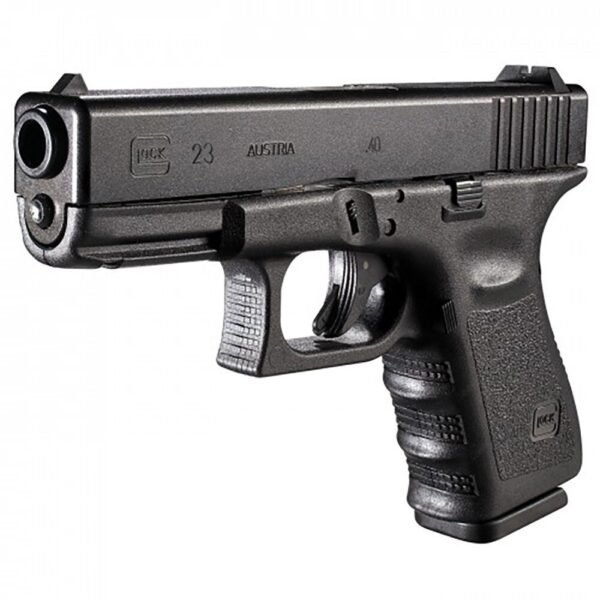
Glock 23 Gen3 .40S&W
Glock PistolsOriginal price was: $499.00.$450.00Current price is: $450.00.
Shop the Glock 23 Gen 3 for sale. This compact .40 S&W pistol offers a 13-round capacity, proven reliability, and dependable performance for personal defense.
- Description
- Reviews (0)
Glock 23 Gen 3: Complete Guide to the .40 S&W Compact Pistol
The Glock 23 Gen 3 is a compact .40 S&W pistol that has earned a long-standing place in Glock’s product history. Designed around a compact frame while retaining the .40 S&W chambering, the platform has been associated with civilian ownership, law-enforcement service, training, and recreational shooting. Glock’s published specifications for the G23 list a 4.02-inch barrel, 7.36-inch overall length, 32 mm overall width, and a standard 13-round magazine capacity.
For readers researching the Glock 23 Gen3 .40S&W, understanding the model’s specifications, generation differences, maintenance considerations, and historical development provides a more useful picture than focusing only on price or accessories. The G23 belongs to the compact Glock family and occupies a position between the larger G22 and smaller G27 in the manufacturer’s .40 S&W lineup.
This guide covers the Glock 23 Gen 3, its core characteristics, how it compares with the glock 23 gen 4 and glock 23 gen 5, and important considerations for anyone researching this model.
 Glock 23 Gen 3 Overview
The Glock 23 Gen 3 was developed as a compact .40 S&W pistol. Its dimensions make it smaller than a full-size G22 while retaining the same basic caliber. Glock describes the G23 as combining compact dimensions with substantial magazine capacity and identifies the model as having been used by numerous law-enforcement agencies.
The fundamental specifications associated with the G23 include:
| Specification | Glock 23 |
|---|---|
| Caliber | .40 S&W |
| Standard magazine capacity | 13 rounds |
| Barrel length | 4.02 inches |
| Overall length | 7.36 inches |
| Overall width | 1.26 inches |
| Height with magazine | 5.04 inches |
| Weight without magazine | 21.16 oz |
| Operating system | Safe Action |
These figures are published by Glock for the G23. Individual historical variants and generations can have differences, so buyers should verify the exact configuration and markings on a particular firearm rather than assuming that every G23 has identical specifications.
The Gen 3 configuration is particularly recognizable because of its traditional Glock frame design and textured grip with finger grooves. It predates several ergonomic and control changes introduced with later generations.
What Makes the Glock 23 Gen3 .40S&W Different?
The defining characteristic is its combination of compact dimensions and .40 S&W chambering. The cartridge gives the G23 a different shooting character from comparable 9mm compact models, while the compact frame keeps the pistol considerably shorter than a full-size .40 S&W handgun.
The Glock 23 Gen3 .40S&W also benefits from the long-established Glock operating system. Glock identifies the G23’s system as Safe Action, and the manufacturer’s current technical information lists the same basic dimensions and capacity for the G23 family.
Glock 23 Gen 3 Design and Construction
The Gen 3 G23 follows the design philosophy that made Glock pistols widely recognizable. Its polymer frame helps keep weight relatively low, while the steel slide and barrel provide the working components required for operation.
The compact dimensions are an important part of the design. At 7.36 inches long and 1.26 inches wide, the G23 is considerably more compact than many full-size service pistols. Glock lists its unloaded weight at 21.16 ounces.
The frame includes the characteristic Glock grip texture and finger grooves associated with this generation. These features give the shooter defined contact points, although hand size and personal preference determine whether the Gen 3 grip geometry feels comfortable.
The slide uses Glock’s established configuration with rear slide serrations and fixed sights. The traditional configuration also reflects the period in which the Gen 3 was designed, before factory optics-ready configurations became widespread.
Ergonomics and Controls
The Gen 3 control layout is intentionally straightforward. Glock pistols are known for a relatively small number of external controls, allowing the shooter to operate the firearm without a conventional manual thumb safety.
Later generations introduced ergonomic and control changes. Consequently, someone familiar with a Gen 4 or Gen 5 may immediately notice the different frame treatment and controls on a Glock 23 Gen 3.
Glock 23 Gen 3 and .40 S&W
The .40 S&W cartridge is central to the identity of the G23. The caliber was developed as a service-pistol cartridge and became particularly prominent in American law enforcement during the late twentieth and early twenty-first centuries.
The G23’s compact dimensions make it substantially smaller than the full-size G22 while maintaining the same basic .40 S&W chambering. This relationship is one reason the glock 23 became an important member of Glock’s compact lineup.
Because .40 S&W produces a different recoil impulse from 9mm, shooting characteristics can vary considerably depending on ammunition, firearm configuration, grip technique, and individual experience. Responsible owners should follow the manufacturer’s instructions and use appropriate ammunition.
Glock’s current G23 specifications continue to list .40 S&W as the caliber and 13 rounds as the standard magazine capacity.
Glock 23 Gen 3 vs Glock 23 Gen 4
The glock 23 gen 4 introduced several notable changes compared with the earlier generation. Glock’s official Gen 4 documentation identifies the model as a compact .40 S&W pistol and lists a standard 13-round magazine capacity, 4.02-inch barrel, and 7.28-inch overall length.
One of the most visible changes is the Gen 4’s Modular Backstrap System. Glock explains that this system allows the grip configuration to be adjusted to accommodate different hand sizes. The Gen 4 also introduced a reversible magazine catch, making the control arrangement more adaptable for left- and right-handed users.
This creates a straightforward generational distinction:
- Glock 23 Gen 3: traditional Gen 3 frame and controls.
- Glock 23 Gen 4: Modular Backstrap System and reversible magazine catch.
- Both use .40 S&W and have a standard 13-round magazine capacity.
The Gen 4 is therefore an evolutionary development rather than a completely different firearm platform.
Glock 23 Gen 3 vs Glock 23 Gen 5
The glock 23 gen 5 represents a more modern development of the platform. Glock’s official G23 Gen5 MOS information identifies the pistol as a compact .40 S&W model incorporating several Gen 5 technologies. These include an nDLC finish, flared magazine well, Glock Marksman Barrel, and ambidextrous slide stop lever.
The Gen 5 also reflects the industry’s increased interest in modernized factory configurations and optics compatibility. The current G23 Gen5 MOS is specifically designed around the MOS optics system, providing a factory-oriented route to mounting a compatible red-dot optic.
The generational progression can therefore be summarized as follows:
Gen 3 → Gen 4 → Gen 5
The progression brought changes to ergonomics, controls, finishes, barrel technology, and other design elements. However, the central concept of a compact Glock chambered in .40 S&W remained consistent.
Glock 23 Gen 3 Magazine
The standard Glock 23 Gen 3 magazine is a 13-round magazine. Glock’s published G23 technical specifications list 13 rounds as standard, with additional capacity options identified for the broader model specification.
Magazine condition is an important consideration for any firearm. Owners should inspect magazines for obvious damage, deformation, or other signs of wear and should follow the manufacturer’s recommendations.
When researching replacement magazines, compatibility should be verified carefully. Generation, caliber, magazine design, local regulations, and the specific firearm configuration can all matter.
Glock 23 Gen 3 Maintenance
Proper maintenance is an important part of responsible firearm ownership. Glock provides owner resources and safety information through its official website, including manuals and other product documentation.
For a Glock 23 Gen 3, maintenance should follow the manufacturer’s instructions rather than generic internet advice. Owners should pay particular attention to:
- Following the manufacturer’s safety procedures.
- Ensuring the firearm is unloaded before maintenance.
- Inspecting the firearm for unusual wear or damage.
- Cleaning according to the manufacturer’s instructions.
- Using appropriate ammunition.
- Inspecting magazines and other components.
- Having questionable components evaluated by a qualified professional.
Glock also states that it does not offer aftermarket parts and recommends against altering or modifying its pistols with aftermarket parts.
That guidance is especially relevant when evaluating replacement parts, custom slides, triggers, barrels, or other modifications advertised for the Gen 3 platform.
 Glock 23 Gen 3 Accessories and Compatibility
The aftermarket ecosystem surrounding the Glock 23 Gen 3 is extensive. However, compatibility should always be verified before purchasing or installing any component.
Common categories discussed by owners include holsters, sights, magazines, storage equipment, range accessories, and replacement components. Accessories should be selected according to the exact firearm configuration and the manufacturer’s specifications.
A particularly important distinction involves optics. The original Gen 3 configuration was not built around the factory MOS system associated with newer Glock models. Consequently, anyone researching an optic-ready configuration should carefully distinguish between a factory configuration and a modified or aftermarket slide.
The same principle applies to barrels, recoil components, triggers, and other parts. Glock specifically recommends against modifying its pistols with aftermarket parts.
Glock 23 Gen 3 Holster Considerations
A properly fitted holster is an important component of safe firearm storage and carry. A holster should be specifically compatible with the firearm and any attached equipment.
When selecting a Glock 23 Gen 3 holster, users should consider:
- Exact firearm model and generation.
- Whether the firearm has aftermarket sights or other additions.
- Retention characteristics.
- Trigger-guard coverage.
- Carry position.
- Material and construction.
- Compatibility with the intended belt or mounting system.
A holster should protect the trigger area and securely retain the firearm according to the manufacturer’s specifications.
Glock 23 Gen 3 Price and Availability
Searches for Glock 23 Gen 3 price can produce substantially different results because the Gen 3 is an older generation and its market status differs from current-production models.
Price can be affected by:
- Condition.
- Originality.
- Included magazines and accessories.
- Finish condition.
- Regional market conditions.
- Dealer pricing.
- Used-market demand.
- Applicable taxes and transfer fees.
Rather than relying on a single advertised figure, prospective buyers should compare current listings from legitimate, licensed sellers and verify the firearm’s condition and configuration.
Because firearm laws vary by jurisdiction, buyers should also confirm all applicable federal, state, and local requirements before purchasing or transferring a firearm.
Glock 23 Gen 3 Performance Characteristics
The G23’s compact dimensions and .40 S&W chambering give it a distinct shooting profile. Its 4.02-inch barrel provides a relatively compact package, while the polymer frame helps keep unloaded weight at approximately 21.16 ounces.
The recoil experience will differ between shooters. Ammunition type, grip, stance, training, and individual sensitivity all affect perceived recoil. There is no universal shooting experience that applies equally to every owner.
For this reason, responsible training should focus on safe handling, fundamentals, and consistent technique rather than relying on generalized claims about performance.
Glock 23 Gen 3 Compared With Other Glock Models
The glock 23 sits within a broader family of Glock pistols.
The G22 is the larger full-size .40 S&W counterpart, while the G27 is a smaller subcompact .40 S&W model. Glock’s historical buyer materials describe the G23 as a compact pistol combining compact dimensions with the .40-caliber cartridge.
The G23 therefore occupies an intermediate position within the traditional .40 S&W Glock lineup:
- G22: full-size .40 S&W platform.
- G23: compact .40 S&W platform.
- G27: subcompact .40 S&W platform.
The Glock 23 Gen 3 is also commonly compared with the Glock 19 because the two occupy similar compact dimensions while using different chamberings. The G19 is chambered in 9×19, whereas the G23 uses .40 S&W.
Safety and Responsible Ownership
Any discussion of the Glock 23 Gen 3 should include responsible firearm ownership. A firearm should always be handled according to established safety rules and the manufacturer’s instructions.
Important principles include treating every firearm as loaded until personally verified otherwise, keeping the muzzle pointed in a safe direction, keeping the trigger finger outside the trigger guard until ready to fire, and knowing the target and what lies beyond it.
Owners should also use secure storage appropriate to their circumstances and comply with applicable laws concerning possession, transportation, storage, and carry.
Glock provides official owner resources and safety materials for its products, making the manufacturer’s documentation an important reference for owners and prospective buyers.
 Frequently Asked Questions About the Glock 23 Gen 3
What caliber is the Glock 23 Gen 3?
The Glock 23 Gen 3 is chambered in .40 S&W. Glock’s official G23 specifications list .40 S&W as the caliber and 13 rounds as standard magazine capacity.
How many rounds does a Glock 23 Gen 3 magazine hold?
The standard G23 magazine capacity is 13 rounds. Glock’s official specifications identify 13 rounds as the standard capacity for the G23.
How long is the Glock 23 Gen 3 barrel?
The G23 has a 4.02-inch barrel. Glock lists the barrel length as 102 mm, or 4.02 inches.
What is the difference between the Glock 23 Gen 3 and Gen 4?
The glock 23 gen 4 introduced features including the Modular Backstrap System and reversible magazine catch. Glock lists the Gen 4 as a compact .40 S&W pistol with a 4.02-inch barrel and standard 13-round magazine capacity.
What is the difference between the Glock 23 Gen 3 and Gen 5?
The glock 23 gen 5 incorporates newer-generation technologies, including an nDLC finish, flared magazine well, Glock Marksman Barrel, and ambidextrous slide stop lever. The current Gen5 MOS version is also configured for the MOS optics system.
Is the Glock 23 Gen 3 still relevant?
The Gen 3 remains historically significant within the Glock 23 family and is still encountered on the used market. Its compact dimensions, .40 S&W chambering, and established design make it a model frequently researched by firearm owners and collectors.
Where can I find official Glock information?
Glock provides product specifications, owner’s resources, safety information, manuals, and FAQs through its official website. These manufacturer resources should be consulted for authoritative information about operation, maintenance, and compatibility.
Final Thoughts on the Glock 23 Gen 3
The Glock 23 Gen 3 represents an important chapter in the development of Glock’s compact .40 S&W lineup. Its combination of compact dimensions, polymer-frame construction, 4.02-inch barrel, and standard 13-round magazine capacity established a recognizable configuration that continued into later generations.
Understanding the differences between the Glock 23 Gen3 .40S&W, glock 23 gen 4, and glock 23 gen 5 is useful when comparing used and current configurations. Gen 4 introduced significant ergonomic improvements, while Gen 5 incorporated additional design updates and, in the MOS configuration, factory-oriented optics compatibility.
For anyone researching a Glock 23 Gen 3, the most important factors are the exact configuration, condition, documentation, compatibility of any accessories, and compliance with applicable firearm laws. Manufacturer documentation should remain the primary reference for safe operation and maintenance.
Only logged in customers who have purchased this product may leave a review.
Related products
Next Product
Glock 22 Gen5 MOS .40 S&W
Reviews
There are no reviews yet.